Song Notes

[Note 100.0] 

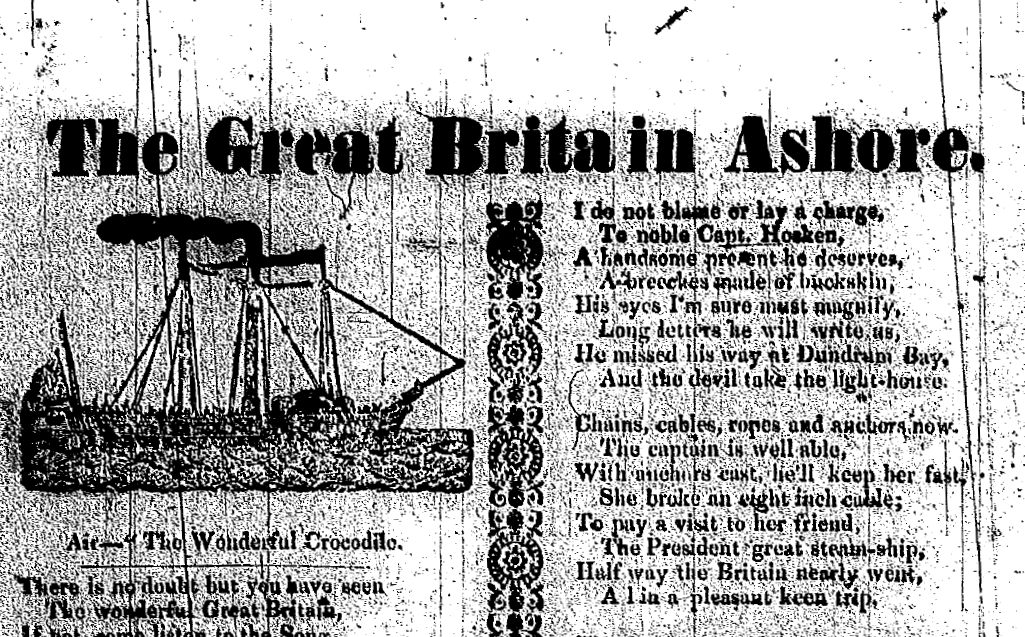
The only instance of this song found to date is on the broadside(1). The references to places in Ireland suggest that it may have been written by an Irish resident of Liverpool.

[Note 100.1] "The wonderful Great Britain" :- SS Great Britain was launched 1843. She was the longest passenger ship in the world from 1845 to 1854 and the first to use a propeller rather than paddle wheels. [ref: https://en.wikipedia.org/wiki/SS_Great_Britain]

[Note 100.2 "For diving in the sand banks " :- In September 1846, after narrowly missing some rocks she ran ashore on the beach in Dundrum Bay. Below - SS Great Britain, beached ashore, Dundrum Bay Ireland, at high water and in a gale by Joseph Walter.

[Note 100.3] "From Liverpool she did set sail...that off to Ireland brought her" :- The accident happened at the start of a routine transatlantic voyage from Liverpool.

[Note 100.4] "Dundrum Bay " :- Is on the coast of Ulster south of Belfast.

[Note 100.5] "Dungannon" :- A town in Ulster. Many miles inland.

[Note 100.6] "Bog of Allen" :- About 50 kilometers inland west of Dublin

[Note 100.7] "There was pick-a-ninnys and fan-dangs" :- . It was common for black adults to be treated as children. the Piccaninnies might have been black entertainers like C.W. Pell's Serenaders shown in the Vauxhall Gardens advertisement below. There would almost certainly have been aristocrats among the passengers.

[Note 100.8] "Van Amburgh's strolling players " :- Isaac A. Van Amburgh (1811–1865) was an American animal trainer who developed the first trained wild animal act in modern times. During the mid-1840s his was the largest traveling show in England. He performed for Queen Victoria and Prince Albert  [ref: https://en.wikipedia.org/wiki/Isaac_A._Van_Amburgh]The advertisement below comes from the Illustrated London News 5th August 1848. No evidence has come to light to suggest that he was on board the Great Britain when she grounded.

[Note 100.9] "The noble Capt. Hoken" :- Captain James Hosken

[Note 100.10] "the devil take the lighthouse" :- The Captain mistook St John's Point light for the Chicken Rock light on the Isle of Man

[Note 100.11] "The President great steamship " :- The SS President was commissioned in 1840. She was lost in the Atlantic in 1841; five years before Great Britain Ashore was written which makes this reference to her rather macabre.  See bar247~President Steam Ship

[Note 100.12] "Castle Hyde" :- about 25 Kilometers north of Cork

[Note 100.13] "As think that ever she'll get clear, For in the mud she's stuck fast" :- She was not was re-floated until in August 1847.

[Note 100.14] "When she is in the graving dock, Just close the gates for ever, Or else she'll fly clean off the stocks" :- Graving Dock: An artificial basin excavated, built round with masonry, and fitted with flood-gates, into which ships are received for purposes of loading and unloading or for repair.  Stocks : The framework on which a ship or boat is supported while in process of construction [OED]

[Note 100.14] "Warren's Pint" :- Warrenpoint is a small town in County Down, Northern Ireland. It lies on the northern shore of Carlingford Lough. Great Britain was taken back to Liverpool for refitting.


[Note 105.0] The first passenger service on the Lower Shannon started in 1816 and continued for approximately one hundred years until the end of the First World War. The steamers were mainly passenger carriers and in the early days ran all year round until in the 1870's they ceased to operate in winter. The four-hour journey from Limerick to Kilrush also at times served Foynes, Killadysart, Cahircon, Redgap, Glin and Tarbert on the way. At Kilrush, (Cappa Pier) passengers could board a four-horsed conveyance for Kilkee. After the opening of the railway between Kilrush and Kilkee in 1892, a special train called the "Steamer Express" ran non-stop from Cappa to Kilkee.
The fares from passengers alone being inadequate to support the vessels a charge was made. for the carriage of Parcels, Beds, Furniture, Wine, Stores and all articles. In addition, Cars, Gigs, Carriages, Horses, Pigs and Chickens etc. were also transported.

[Note 105.1] "The Elwy steamer":-

[Note 105.3] "Can beat the train that goes by rail":- The chief competition to the steamers on the lower Shannon was the railway serving Foynes and Tarbert opened in 1858. It seems that Elwy could not compete with the railway and was withdrawn after a few weeks [ref: ] and sold to Constantinople in 1869 [ref: http://www.dalmadan.com/?p=329]

[Note 105.3] "He brought her here to serve our town":- The Clare Journal and Ennis Advertiser reported on 7th July 1867 under the headline "New Steamer for the Shannon" that "A splendid new steam boat of great speed has been purchased by the Mayor of Limerick to ply between this City and Kilrush. The name of the vessel is the Elwy which left Liverpool at 1.30 on Saturday so that she will not arrive in the Shannon until this Monday morning. We trust the citizens of Limerick will appreciate as it deserves such enterprise on the part of the Mayor for their benefit and comfort."

[Note 105.4] "Brave Tait our gallant hero":- The Elwy was chartered by Peter Tait, Mayor of Limerick

[Note 105.5] "Her powerful engines strong indeed":- Elwy was a large vessel perhaps more suited to the more exposed waters of the Irish Sea. [Ref: http://www.dalmadan.com/?p=329]

[Note 105.6] "The grandest folk in Erin's land, Her noble steward awaits them":- The Limerick Chronicle, 11th July 1867 reported under the headline "Excusrion on Board the Elwy" that "On yesterday, in accordance with the invitation which he had given on Tuesday, his Worship the Mayor, entertained the members of the Town Council, several private friends, as well as the heads of the various local establishments, with an excursion trip down the Shannon on hoard of his magnificent steamer the Elwy,

The time announced for the excursion to take plane was eleven o'clock, but in consequence of the dock gate not having been opened at that time, as the tide was not sufficiently high, about an hour elapsed before the steamer left the dock. During the interval the company began to assemble, and there was an immense crowd of the populace on the pier and adjoining quays, and Shen the steamer left the dock, and rounded the pier, a grand cheer arose from the multitude, which was responded to by the company on board, and the noble vessel went on her pleasant journey, amid the continued plaudits of the populace, and which had not ceased till Barrington's Quay had been passed.

The splendid band of the County Limerick Militia were on board, and added very much to the enjoyments of the day, in the performance of a selection of music, comprising chiefly Irish and Scotch airs -  When the Elwy had passed the dock gate the company went on board at the inner, or eastern pier, preceded by his Worship the Mayor, and the Corporation officials, the band appropriately striking up "See the Conquering Hero comes."

[Note 105.7] "Full speed from here to Kilrush quay":- "Here" is presumably Limerick.

[Note 105.8] "And calls at Tarbert station":- Historic railway maps give no indication that a Tarbert Station ever existed. However; there is a ferry across the Shannon from Tarbert to Killmer which would have been a likely point of call for the Elwy.

Glossary entry : "Our mayor for certain takes the sway":- To take the sway is to be the most important or influential.

[Note 618.1] "A SHORT farewell to smoke and noise" :- London's population was one million at the time of the first census in 1801 and it more than doubled by the second census in 1851. [Ref: Old Bailey on Line https://www.oldbaileyonline.org/static/London-life19th.jsp]. The noisiness of London streets was a common source of complaints made by middle and upper class Londoners. The concomitant increase in use of coal as both domestic and industrial fuel resulted in the smogs for which London became notorious.

gloss "fish fags In English public schools, a junior who performs certain duties for a senior.

gloss railers" :- Meaning unknown To mill about, go to and fro; to wander, roam although the latest date for this meaning cited by the OED is 1567

[Note 618.2] "Around sweet crowded Billingsgate" :- Billingsgate wharf was close to Lower Thames Street. Boats delivered fish to this small inlet of the Thames and business was conducted on the quayside.


gloss Hollo: a call to excite attention [OED]

gloss "Cup mate" :- Cup: meaning not known

[Note 618.3] The London Engineer was built in 1818 for the Margate Steam Packet Company. she was unusual in having her paddle wheels inboard as shown below.

[Note 618.4] The first of three ships called Eclipse was built in 1816 and was in service for the same company until 1823 [ref Dix, F Royal river Highway, A history of the passenger boats and services on the river Thames.p 237and 247].

[Note 618.5] Mogg's Table of the new Watermen's Fares, published in 1828 cites a rate of one shilling per half hour for 6 customers. [ref: Regency Reader website http://www.regrom.com/2017/03/08/regency-travel-wherries-on-the-thames/] suggesting the waterman in the song is asking an exorbitant rate.

gloss "lawk" :- lawks-a-mercy; Lord have mercy [OED]

gloss - Dun(1): One who duns; an importunate creditor, or an agent employed to collect debts [OED]

[Note 618.6] "Mr Smelt" :- A smelt is a fish; hence Mr Smelt is a fishmonger.

gloss Grig A grasshopper or cricket [OED]

a pickle a difficult situation. [CPB]

a pucker A state of agitation, excitement, or haste; a fluster, a fuss [OED]

[Note 618.7] Fires were all too frequent in wooden paddle steamers. It was very unusual for anybody, even a sailor, to be able to swim at this time.

[Note 618.8] "you would think nothing of being blow'd up now and then " :- Blowed up - to be the object of anger; to be admonished fiercely

gloss hanging in chains " :- Those who had been sentenced to death by Admiralty courts were executed at Execution Dock. In the cases of the most notorious offenders, the Admiralty would order that their bodies were to be tarred and hung in chains at either Cuckold's Point or Blackwall Point.
https://en.wikipedia.org/wiki/Execution_Dock


Hulks" :-

[Note 618.9] the hulks moored on the Thames. Many prisoners served their entire sentence on the hulks. In 1798 it was reported that more than 1400 out of a total of almost 1900 people waiting for transportation to Australia were confined on the hulks.


[Note 618.10] Tilbury Fort is on the north, bank of the River Thames and was built to defend London from attack from the sea, particularly during the Spanish (not Danish) Armada. Presumably both are deliberate errors for comic effect.

[Note 618.11] "The sailors quick hoist up a sail" :- This picture shows a Margate steamer "Getting into a Breeze" in 1829


gloss Southdown; a breed of sheep.

[Note 618.12] "my dear, don't you eat too much of the turnips, perhaps you'll be sick-fie, papa, you might say un-well." The habit of avoiding direct reference to bodily functions was becoming established by 1820. The use of "fie" and "lawk" suggests that the trend is being lampooned in this piece.

gloss fie" :- An exclamation expressing, in early use, disgust or indignant reproach. Sometimes more fully fie, for shame! [OED]

[Note 618.13] "I have been up to Richmond in a cutter" :- Dix [op. cit. p26] says rowing boats continued to operate services from London to Richmond for many years after the introduction of steam. He says that he boats were called passage boats and were heavy 'randans' rowed by three men rather than the cutter claimed here. Traditional Thames cutters would fit the description of a randan to an inexpert eye.

bushel: A measure of capacity used for corn, fruit, etc., containing four pecks or eight gallons [OED]

[Note 618.14] "this better than travelling by the coach-allow'd eight minutes to eat your dinner...oh, the devil take all travelling excepting by steam" :- Railway passengers were later to complain about the brevity of the stops made for passengers to eat and drink. (see bar326~Railway Belle). The practice seems to have been inherited from the coaching companies.

gloss "queerish" :- Slightly ill

gloss "daddy Neptune has got his night-cap on " :- The sea is calm. ;

gloss a night cap is a cap worn in bed or with nightclothes. [OED]
Ebenezer Scrooge, from Charles Dickens's A Christmas Carol wearing his pajamas and nightcap. Illustration by John Leech.


[Note 618.15] "paring of a potatoe" :- a piece of potatoe peeling

[Note 618.16] "you've lost the Reculvers" :- Reculver is a village on the south bank of the Thames estuary about miles east of Margate. (Now largely lost to erosion by the sea) The towers of St Mary's church - sometimes known as Reculver towers - are a distinctive landmark.

[Note 618.17] "they pluck all that's worth having of them and set them flying, and in the course of the season they stand a chance of picking them up again" :- Nicholas Daly says that wearing gull feathers and body parts in hats had begun at least as early as the 1860s. [Daly, N. The Demographic Imagination and the Nineteenth-Century City p168]

[Note 618.18] "only look what a number of genteel people on the pier " :- image Margate from Hazardous Row ,1809; engraved by Joseph C Stadler shows the "pier", bathing machines, and some "genteel people" on the pier. http://www.rareoldprints.com/p/10730


[Note 618.19] "Favourite" :- Favourite was built in 1817. It was owned by Gravesend Steam Packet Company 1817 to 1819 and by the Margate Steam Packet Company from 1820 to c1828 [Dix op. cit.p239]. The text implies that Favourite was visiting Margate when the song was written. If that is true the song can be confidently dated to 1820

[Note 618.20] "Majestic...Victory" :- The Margate Steam Packet Company boat Majestic was built in 1816 and Victory was built in 1818; "Victory" in 1818 [Dix op. cit. p248]

variant A slightly shorter version of the song was printed in the Universal Songster Vol I, pp13-16 in 1834 under the title Margate Steam Packet. (see bar244). The tune given there is the Military Air of the Nightingale. No tune of that name has been found.


[Note 106.1] The Eagle was built in 1816 [ref: Ransom, P; Bell's Comet: How a Little Paddle Steamer Changed the Course of History, p122] Ransom  suggests that the vessels depicted here are probably The Eagle with the Swift in the background to the right; and that the American ship in the background to the left is artistic licence.[Ransom p108].

The Early Clyde Steamboats website however suggests that it might be the Argyle another Tyne-built vessel [ref: http://www.dalmadan.com/?p=1101]
 
[Note 106.1] The song seems to describe a pleasure trip. The lines "Now when they to the Pier drew nigh, / The guns did fire and streamers fly ;/ In a moment all was hue and cry, / Amang the folks at Sunderland" in verse 2 suggest that it might have been the steamer's first visit to Sunderland.

[Note 106.2] "Barber's 'water-proof silk hat" - J Barbour and sons was founded in South Shields in 1894, long before this song was published. However this line rasies the possibility that the family were producing waterproof garments in the area before the company was established.

[Note 106.3]  "And bloody noses unawares, were got in sight of Sunderland" - In rough weather the paddle on one side of the boat might rise completely out of the water leading to violent jolting of the vessel and its passengers.

The song was long-lived and is included in The Tyneside Songster of 1899. (Roud B224474)

[Note 049.0] In their efforts to win as much business as they could, railway companies created complicated systems of interconnecting lines and intersecting train services.

Every large city had its own examples of these crossovers. The so called "Battersea tangle" was among the most spectacular.


Bexhill is on the south coast. Our hero blunders round London north of the Thames before crossing it southward to Clapham Junction and then re-crossing northward to Victoria. 

[Note 049.1] “Here, keb, sir?... d'you want a four-wheeler?”; a cab of the style shown below rather than a two-wheeled Hansom cab.

[Note 049.2] “Don't slang an unfortunate bounder”; is a play on words. The Oxford English Dictionary (OED) gives two relevant meanings for “bounder”: one being “A person of objectionable manners or anti-social behaviour; a cad. Also in milder use as a term of playful abuse” and the other “A four-wheeled cab or trap, so called from the bounding motion of the vehicle in passing over rough roads. The OED also gives two relevant meanings of “slang”: to cheat or give short measure; or to [verbally] abuse.

[Note 049.3] “It was back in the time of the strike, Sir,”; may be a reference to the national railway strike of 1911


Please publish modules in offcanvas position.