1 note

Workhouses were built in the late 1830 and into the 1840s (when this song was written). It is likely that the economic slump during the "hungry 40's" resulted in increased numbers of destitute people entering the workhouse but no figures have been found to support the assumption. The line "hundreds now that can't get in, do starve outside the door" may be inspired by the sight of people seeking the shelter of the Casual Wards. Bruce Rosen wrote that[i] The Poor Law Commissioners recommended that this" [casual wards] "should be provided as short term shelter (usually for a single night) and a meal in return for work…Those who sought such short term accommodation were separated from the longer term residents of the workhouse confined to the "casual" wards. According to Norman Longmate, the 'standard policy' which was developed to deal with such short term applicants was 'to make the vagrant's life so disagreeable that he would hesitate to come back.' … After queuing, sometimes for hours, and if there was space available, a casual might be admitted through the single entrance near which were the casual wards. A casual ward might consist of a large room with some bedding and a bucket for sanitation. The bedding was often nothing but straw, with rags for coverings as in the Richmond workhouse in the 1840s. In return for this largesse, the occupant was required to do a set amount of work before leaving on the following day. Often this work was soul-destroying. Men might have to spend hours breaking stones while women were set to picking oakum." A.N. Wilson [ii] has written "It is estimated - and we are speaking her of the years before he Irish potato famine - that more than a million paupers starved from simple lack of employment" Refernces: [i] Rosen, Bruce The Victorian Casual Ward, Victorian History website http://vichist.blogspot.com/2012/12/the-victorian-casual-ward.html [ii] Wilson, A. N. The Victorians (London, Huthcinson, 2002)

The stage wagons used by poorer folk moved at walking pace and were much slower than the stage coaches used by the better off. Roy Palmer says that "The stage wagons had a particular place in the affections of country people." [i] and quotes E. W. Bovill: "When the poor had to travel they used the old-fashioned stage wagons, drawn by four, six, or even eight horses, which were chiefly used for the carriage of goods. They never moved out of a walk and were in charge of a carter who usually walked beside his team." [ii] The date of the songs suggests that the line "For they travel on hot water, and they melt long miles by steam" refers to railways rather than steam coaches.
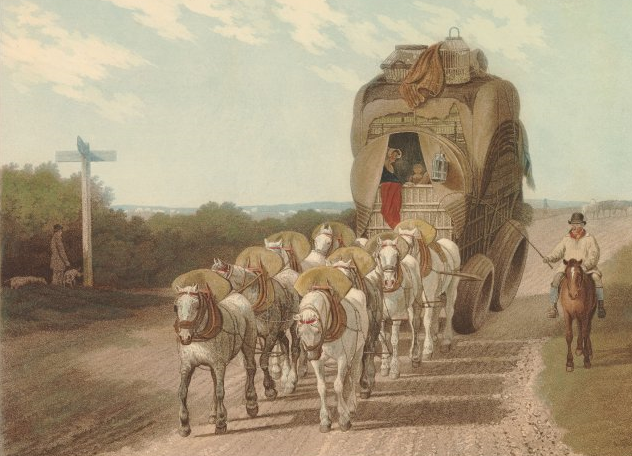
549.5Wagon.png

 A Stage Wagon of the early 19th century


References:
[i] Palmer, Roy. A Touch on the Times
[ii] Bovill, E.W. English Country Life

Picture: British Museum No 1939,1014.19

The Thames Tunnel, from Wapping to Rotherhithe was the first tunnel under a river anywhere in the world. tunnel was opened in 1843. It was of an horseshoe construction with a height of 7m/23ft and width of 11m/37ft. It had a total length of 406m/1,506ft. In the first four months more than a million people passed through the long awaited tunnel. [i] At least two songs were written about the tunnel [ii]. This is from the cover of one of them. 

549.6Tunnel.png

References:
[i] http://www.ikbrunel.org.uk/thames-tunnel
[ii] The Thames tunnel written and composed by J. A. Hoy ; arranged by F. Lancelott. British Library Shelfmark Music Collections H.1756.(46.) and The Thames Tunnel. A very popular comic song. Written by Mr. James Bruton .with an accompaniment for the piano forte by J. T. Craven. British Library Shelfmark Music Collections H.1652.v.(6.)

Please publish modules in offcanvas position.