1 note

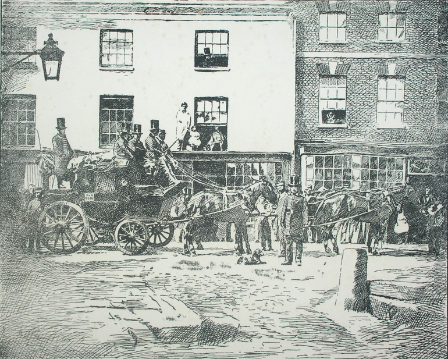
The Great Western railway reached Falmouth in 1863 and led to the immediate closure of the stage coach to Exeter and London.

473.2LastMail.png

The last four horse mail coach leaving Market Strand Falmouth for Plymouth 1863
https://www.falmouthartgallery.com/Collection/1000.90 (accessed 25Mar21)

Falmouth to London is less than 250 miles however; by 1863 an enthusiastic rail traveller could cover 400 miles in a day.

Breach-of-promise:- A man's promise of engagement to marry a woman was considered, in many jurisdictions, a legally binding contract. If the man were to subsequently change his mind, he would be said to be in "breach" of this promise and subject to litigation for damages. Breach of Promise actions were part of the standard stock-in-trade of comic writers of the period (such as Charles Dickens in his Pickwick Papers, or Gilbert and Sullivan in Trial by Jury) , but most middle- and upper-class families were reluctant to use them except in rather extreme circumstances (such as when a daughter became pregnant by a man who then refused to marry her), since they led to wide publicity being given to a scrutiny of intimate personal concerns, something which was strongly repugnant to the family feeling of the period (especially where young women were concerned).[i]

In the late 19th century, several Bills were introduced in the House of Commons, seeking to abolish the action for breach of promise, but none of them became law. [ii]

References:
[i] http://en.wikipedia.org/wiki/Breach_of_promise (accessed 13Sep20)
[ii] Simon, David - Gliasyers Solicitors http://www.glaisyers.co.uk/Breach%20of%20Promise.htm
On the railway a white flag or light meant all-clear, red meant danger or stop and green originally meant caution. With the increasing use of gas and electric white lights the significance of green changed to all clear as of about 1893. As with most changes this took several years to apply, the GWR adopted green for all-clear in 1895 but green was still occasionally associated with a cautionary warning until the 1960's.

Reference:
British Railway Signals
http://www.igg.org.uk/gansg/3-sigs/sigs-1.htm#:~:text=With%20the%20increasing%20use%20of,cautionary%20warning%20until%20the%201960's. (accessed 22May21)

Shudehill in central Manchester was the scene of the "Shudehill Fight" during 1757 - a series of riots directed against high prices of food and the adulteration of flour.

Reference:
Palmer, Roy - A Touch on the Times Songs of Social Change 1770 to 1914 (Penguin Education, 1974) p63.

Please publish modules in offcanvas position.