1 note
1 note
Gravesend was at its peak as a leading resort in the 1830s and 1840s. New houses, new streets, hotels, reading rooms, public baths, and pleasure gardens were built, Gravesend's success largely stemming from its accessibility by steam packet.[i] The Gravesend Steam Packet Company began operating between London and Gravesend in 1817 By 1841 seventeen steamers ran daily from London to Gravesend. Most charged only 5 pence per person. [ii]
References:
[i] English Heritage & Kent County Council; Kent Historic Towns Survey, Gravesend, Archaeological Assessment Document p12. http://archaeologydataservice.ac.uk/archiveDS/archiveDownload?t=arch-459-1/dissemination/pdf/Gravesend.pdf
[ii] Dix, Frank L. - Royal River Highway: A History of the Passenger Boats and Services on the River Thames. (David & Charles,1985) p77
|
|
The headblock for the broadside was clearly a copy of a detail from a woodcut in Moore's Prophetic Almanack for 1837 Reference: |

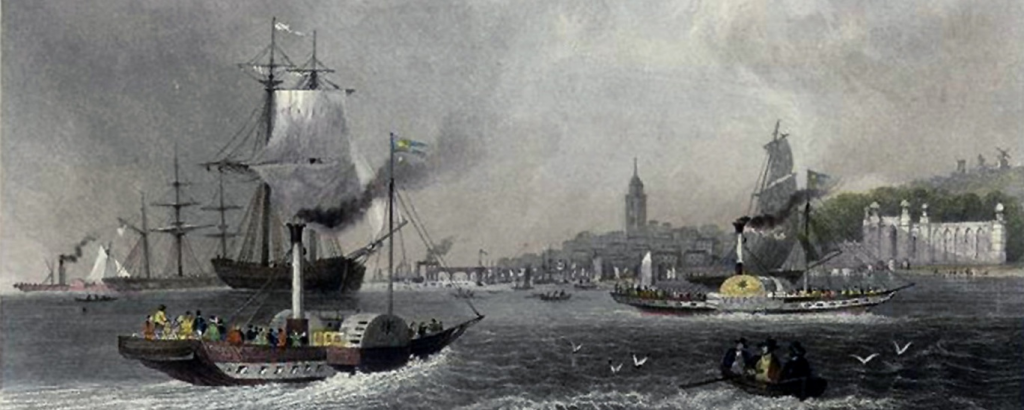
It is obvious from this engraving of Gravesend by H. Adlard after W.H. Bartlett published in 1842 that there was very little shelter for passengers. [i] The lettering on the paddle box of the steamer on the right is indistinct but it might be the Vesper operated by the Star Steam packet Company from 1842. [ii] Windmill Hill - mentioned in the following verse - is at the far right.
References:
[i] ihttp://www.gravesend-kent.kentpoi.co.uk/files/stacks_image_2306.jpg
[ii] Dix, Frank L. - Royal River Highway: A History of the Passenger Boats and Services on the River Thames. (David & Charles,1985) p268